
Most Local Businesses Don’t Have a Marketing Problem. They Have a Clarity Problem.
When a local business owner tells me their marketing isn’t working, the first thing I do is ask them to explain their business to me as if I knew nothing about it.
Not the services. Not the prices. Not the platforms they’re on. Just: what do you do, who do you do it for, and why would someone choose you instead of someone else?
Most of the time, the answer takes a while to arrive. It changes shape mid-sentence. It covers too many people, or describes a service that sounds almost identical to what every competitor would say. And by the end of it, we haven’t found a marketing problem. We’ve found something earlier — a clarity problem.
This is more common than most marketing advice acknowledges. And it’s important to name it clearly, because the solutions to a clarity problem are very different from the solutions to a marketing problem. Treating one as the other is one of the most consistent ways I see local businesses waste money.
According to research by Nielsen, 59% of consumers prefer to buy from brands familiar to them — and familiarity is built on a consistent, recognisable message, not on presence across multiple channels. When the message is unclear, more presence simply means more confusion, not more customers. (Source: Nielsen — Consumer Trust in Advertising)
What a Clarity Problem Actually Looks Like
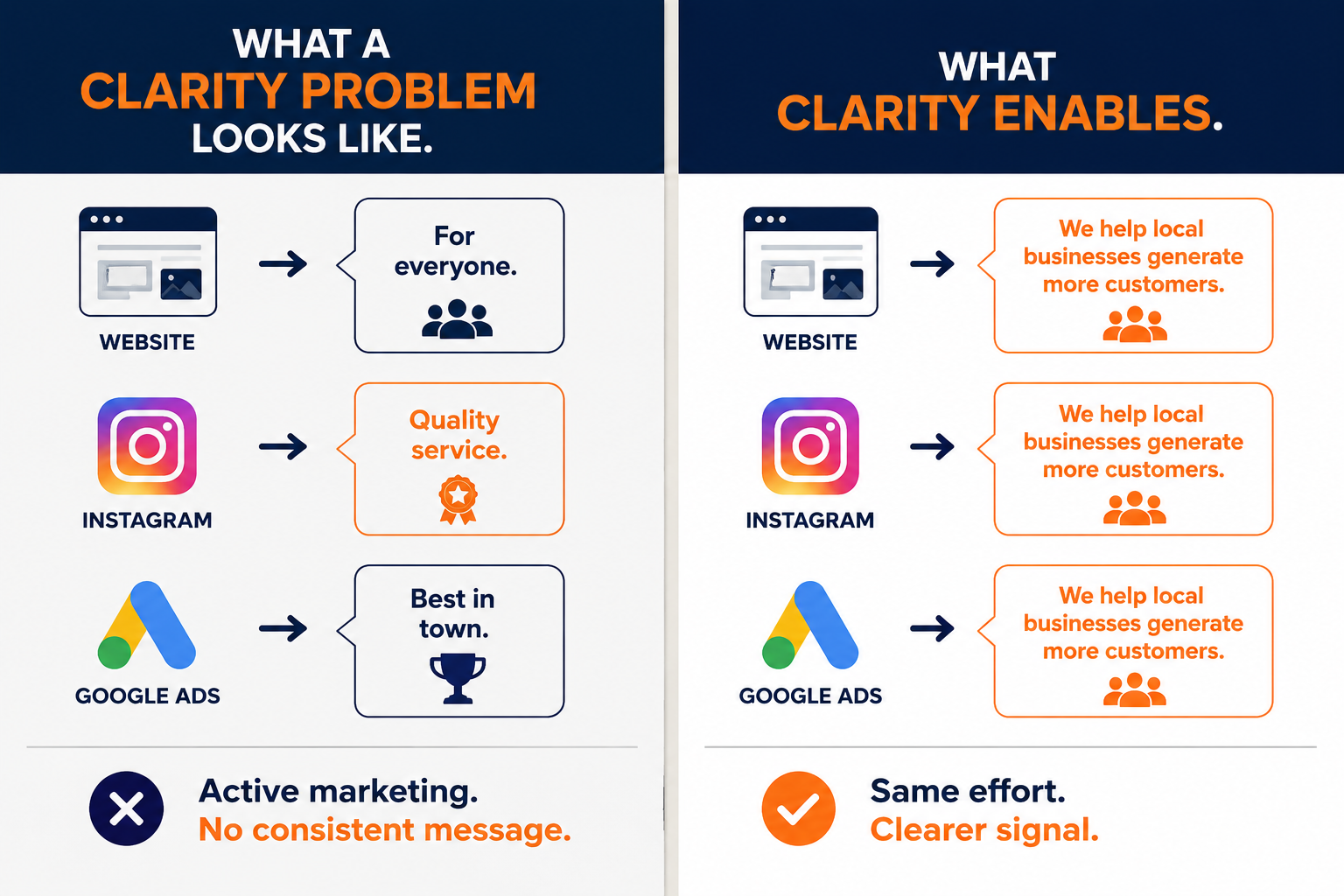
A clarity problem isn’t always obvious from the outside. The business has a website. It has an Instagram account. It might have Google Ads running. From a distance, it looks like a business doing marketing.
What you can’t see from the outside is what happens when a potential customer arrives at any one of these touchpoints. The homepage describes a broad range of services with no clear signal of who they’re for. The social media posts alternate between promotions, motivational quotes, and behind-the-scenes content with no consistent theme. The ads drive traffic to a page that could be describing any business of that type in any city.
The marketing is happening. But the message underneath it — what this business is, who it’s for, and why it’s worth choosing — has never been made clear.
When I look at the symptoms, they follow a pattern:
- The business gets some customers but can’t describe a consistent profile of who they are
- Marketing spend increases but enquiry volume stays roughly flat
- The ads get clicks but the conversions are low, and it’s unclear why
- The social following grows slowly and the engagement is low-quality
- Referrals come in but there’s no clear reason — people seem to recommend the business in vague terms
Each of these looks like a channel problem or a tactics problem. More often, it’s the same underlying issue expressing itself across all of them.
Why Marketing Can’t Fix What Clarity Needs to Solve
Here is the way the confusion usually starts. A business is getting inconsistent results. The owner feels the problem is that they’re not visible enough, or not investing enough in advertising, or not posting enough on social media. So they do more — more posts, more budget, more platforms.
And the results stay inconsistent.
The diagnosis is wrong. Not because visibility doesn’t matter. It does. But visibility multiplies what’s already there. If what’s already there is a message that doesn’t connect — because it’s trying to appeal to everyone, or because it sounds like every competitor, or because it hasn’t been built around a real understanding of what the best customers actually care about — then more visibility just delivers that unclear message to more people.
A larger audience for an unclear message doesn’t produce more customers. It produces more noise.
This is the core of why treating a clarity problem as a marketing problem produces frustration rather than results. The marketing is working exactly as well as the message allows it to. The ceiling isn’t the channel. It’s the clarity of what the channel is delivering.
The Three Places Clarity Usually Breaks Down
In my experience, the clarity problem almost always sits in one of three places. Sometimes it sits in all three at once.
1. Unclear positioning.
The business hasn’t made a choice about what it’s for and what it isn’t. It serves a broad range of customers, offers a wide menu of services, and tries not to exclude anyone. This feels sensible — especially in the early years of a business — but it creates a signal that’s hard to amplify. Positioning isn’t about being exclusive. It’s about being specific enough that the right person recognises themselves in what you do.
2. Unclear message.
The business may have a clear sense of what it does, but the language used to communicate it hasn’t been worked out. The website describes features and services rather than outcomes and relevance. The ads use generic phrases that every competitor could use equally. When a potential customer reads the homepage, they understand what the business offers — but not why they should care. The message hasn’t been built around what actually matters to the person reading it.
3. Unclear customer.
The business has a general sense of who its customers are — people in the local area, families, professionals — but hasn’t developed a specific understanding of what motivates the best customers to choose them. Which customers come back most often? Which ones refer others? What did they say when they first made contact? What problem were they trying to solve? Without that specificity, the marketing is aimed at an abstraction rather than a real person.
Any one of these gaps creates a ceiling. All three together make the marketing feel like it’s constantly underperforming — because it is.
The Diagnostic Question That Surfaces the Problem
There’s one question I’ve found more consistently useful than almost any other in diagnosing whether a business has a clarity problem. It’s not about marketing at all.
If your best customer was describing your business to a friend who needed what you offer, what would they say?
Most business owners find this question harder than they expect. They can describe what they offer. They struggle to describe why their best customers value it specifically — in the language a customer would actually use, not in the language the business uses to describe itself.
This gap — between how the business describes itself and how its best customers experience it — is usually where the clarity problem lives. When the business starts closing that gap, the message changes. The positioning sharpens. The marketing suddenly has something clearer to amplify.
The insight is almost never that the business needs a new channel or a bigger budget. It’s that the business needed to understand itself — and the people who value it most — more clearly first.
What Happens When Clarity Is in Place
When the three clarity foundations are in place — positioning, message, customer — marketing activities start to produce results that compound rather than plateau.
The website conversion rate improves because the message on the page is now specific to the person reading it. The ads generate better quality leads because the targeting and the copy are aligned with a real understanding of who the best customer is. The social media posts build trust because they reflect a consistent point of view rather than a calendar full of disconnected content.
None of the channels changed. The clarity underneath them did.
This is also when the question of budget and scale becomes relevant again. Scaling a marketing system built on clarity produces compounding results. Scaling a marketing system built on an unclear message produces compounding waste.
Most marketing problems are clarity problems in disguise. And clarity problems don’t get solved by doing more marketing. They get solved by stepping back, getting specific, and making sure the foundation underneath the activity is solid before the activity gets louder.
Structure first. Then scale.
If the marketing isn’t producing the results you expected — and you’ve tried different channels, different campaigns, or different budgets without a consistent change — the problem is often upstream of the marketing itself. Book a free strategy conversation. We’ll start by diagnosing whether what’s in place is built on a clear enough foundation — and what needs to be made specific before anything else gets scaled.